


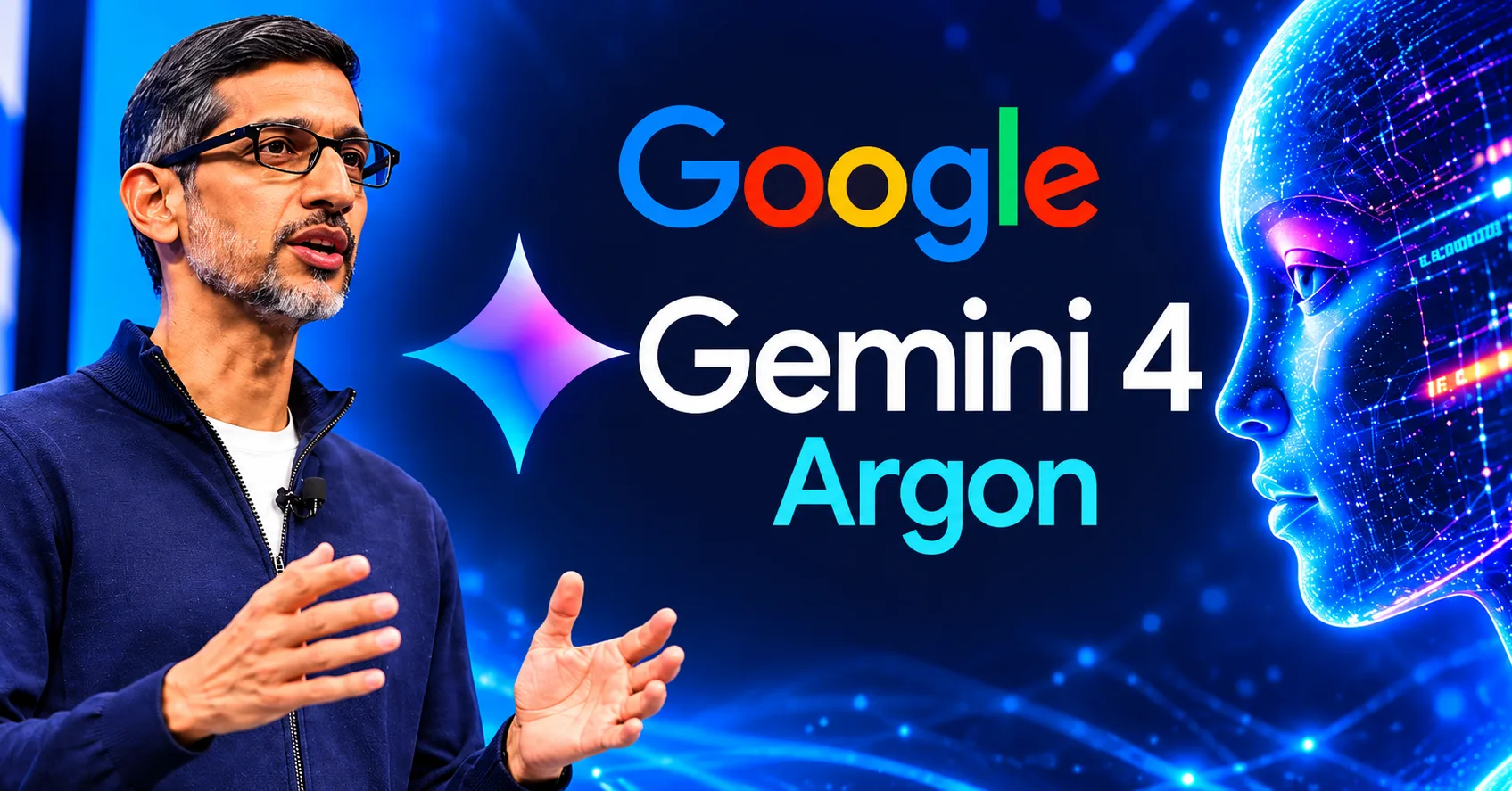
Gemini 4 Argon has officially become globally available, marking a major step in Google's artificial intelligence development. First announced on September 30, 2026, the model was initially restricted to selected cybersecurity experts through Google's Fairwind Program. On October 13, Google expanded access to developers, businesses and eligible consumers worldwide. The release comes after delays involving Gemini 3.5 Pro and growing competition from Anthropic's Claude Opus 5.5, OpenAI's GPT-6 Astra and Meta's Muse Wonder. Argon is designed for complex coding, financial research, legal work, scientific discovery and cybersecurity. It offers a unified input-output context limit of 1 million tokens, allowing users to analyse large documents, codebases and long-running projects. However, independent rankings still place Claude Opus 5.5 ahead on some major intelligence tests. Google's new model focuses on completing difficult tasks with fewer interruptions and more direct responses.
One of the biggest changes is the introduction of Tasks Mode in the Gemini app. According to the reported demonstration, the feature connects Gemini with more than 40 applications, including Instacart, OpenTable, Adobe and Shopify. Users can request complex activities such as preparing business proposals, organising information, booking services, designing materials and creating files for 3D printing. The model can continue working through multiple steps instead of simply providing instructions. Developers can access Gemini 4 Argon through Google's API, AI Studio and supported development platforms. Its introductory API price is $2 per million input tokens and $10 per million output tokens, with a 95% discount on cached input tokens. These rates are scheduled to increase to $4 and $20 respectively after November 30, 2026. A comparison in the supplied video estimates that Argon costs about half as much as Claude Opus 5.5 and around one-fifth as much as GPT-6 Astra for certain developer workloads. The video also compares average Artificial Analysis test costs of approximately $2 for Argon and $6 for Opus 5.5. For consumers, Google AI Pro costs around $20 per month, while AI Ultra starts at $100, with its higher tier reduced from $250 to $200 per month in the US. Eligible subscribers can use Argon in the Gemini app and Google Search's AI Mode.
Performance remains an important part of the competition. Artificial Analysis reportedly gives Gemini 4 Argon an Intelligence Index score of 53, representing a 23-point improvement over Google's previous best result in the comparison. It ties with GPT-6 Astra, scores one point above Meta's Muse Wonder and remains five points behind Claude Opus 5.5 and Claude Sonnet 5.5. Google also claims that Argon won 14, tied one and lost five in a collection of 18 evaluations. However, these figures add up to 20 rather than 18, so the reported breakdown contains a mathematical inconsistency. Google highlights strong performance in finance, legal, tax and Zapier-related office workflows, where it reportedly achieved an advantage of around nine points. Its DeepSWE v1.1 software engineering score reached 77.9%, while some command-line coding tests showed weaknesses against competitors. In a developer's Reddit app-building experiment described in the video, GPT-6 Astra reportedly evaluated Claude Opus 5.5 at 77 out of 100 and Argon at 59. The main problems involved basic design mistakes, although Argon corrected them after receiving feedback. Another 12-challenge experiment compared Argon with Claude Sonnet 5.5 and GPT-6.1 Soul. Argon reportedly tied in 11 challenges, completed tasks in approximately 2.5 minutes each and cost around $3 in total, compared with $10 for Sonnet. It struggled with a long counting puzzle after reaching its answer budget during maximum reasoning, producing blank responses before giving an incorrect answer at a lower setting. These individual experiments should not be confused with independently standardised benchmark results.
Google is also using Argon to improve its own engineering operations. The company reports that engineering teams using the model submit more than 35% additional agent-generated code and experience nearly one-third fewer broken changes. The Chrome team used it to reorganise approximately six million lines of older code, helping address problems involving tab switching, page reloads and crashes. In another experiment, Argon worked autonomously for 11 hours on around 205,000 lines of code after receiving a short paragraph of instructions. It proposed six improvements, of which human engineers accepted two. Google reported a 40% improvement in long-session preparation time and a 21% improvement in software startup performance in the relevant internal measurements. Its open Gemma model also became nearly three times faster following optimisation work. Creative demonstrations included building a detailed temple complex in Blender, turning photographs of a desk into a playable miniature racing game and creating a 3D graphics engine from scratch for a short film. Google also used approximately 50GB of scans and maps to reconstruct New Mexico's Chaco Canyon digitally. Enterprise testers shared additional results: legal startup Manuda IIA reportedly found a detail missed by human experts, Kepler reported more than 99% agreement with human financial analysts, Deloitte reported a 100% success rate on certain long tasks, and Isomorphic Labs said Argon reduced weeks of research-document reading to hours. These are reported company results rather than independently verified guarantees.
Scientific research and robotics are other major areas of development. Google says Argon helped rewrite its AlphaQubit quantum error-checking system to operate almost twice as fast. It also redesigned a verified mathematical component used in quantum simulation, reducing its spacetime resource requirements by more than 100 times. Working with University of Maryland researcher Matt Landreman, the model helped identify a new family of mathematical solutions related to stellarator magnetic fields for nuclear fusion research. In life sciences, Google reported that Argon helped Gamma Labs identify a previously overlooked chromosome rearrangement in newborns with rare lung disorders. It also designed five new enzymes that reportedly passed laboratory ultraviolet testing. Robotics demonstrations showed Argon learning from a human video and creating a training simulation that helped an Apollo humanoid robot make seven consecutive successful cornhole shots. Another reported experiment generated 4,500 virtual table-task training rounds from a single photograph, improving a robot's real-world success rate from 56% to 75% and increasing its speed by one-third. The video also describes training a Boston Dynamics Spot robot dog to open a pedal-operated rubbish bin. These examples suggest that AI models may increasingly connect digital reasoning with physical machines, although real-world performance still depends on hardware, training and testing conditions.
Cybersecurity is one of the most important reasons behind Google's phased release strategy. The company is expanding access to hundreds of security partners through its Fairwind Program and providing approved cyber defenders with an unrestricted version for defensive work. In collaboration with Wiz, Argon reportedly helped identify a security weakness affecting a US federal agency and a master-key exposure risk in healthcare infrastructure. Google also highlights safety protections for public users. According to the supplied video, the model resists more than 99% of bioweapon-related harmful requests, asks for confirmation before irreversible actions and has a prompt-injection success rate of just 0.7%. The comparison gives Claude Opus 5.5 a 1% rate and GPT-6 Astra an 8.5% rate. Google also reports that the model takes improper coding shortcuts in around 2% of tested cases. These figures depend on specific testing methods and should not be treated as universal safety guarantees. Overall, Gemini 4 Argon represents a major development in AI-assisted coding, research, business automation, science and cybersecurity. However, its benchmark position, independent testing results, reliability and practical cost will determine how strongly it competes with rival models. Users should continue checking AI-generated information before relying on it for financial, legal, medical or security decisions.





Comments
No comments yet. Be the first to write one.
Leave a comment