


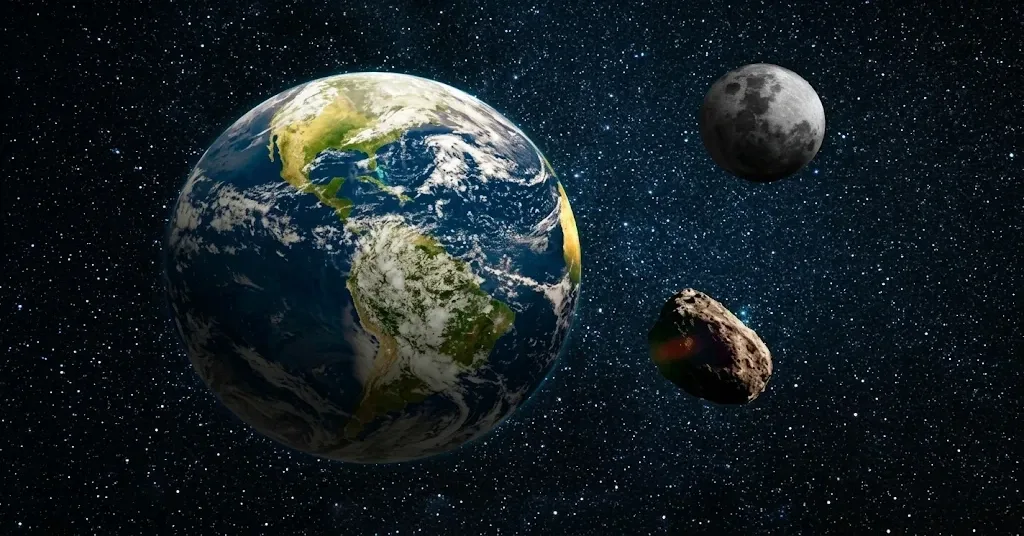
A tiny asteroid named ‘2026 QQ8’ is currently orbiting Earth as a temporary natural satellite, earning it the nickname ‘mini moon’. Measuring approximately 6 feet across, the space rock entered Earth's gravitational sphere earlier this year. However, its stay will be short-lived. Scientists estimate that it will remain near Earth until December 2026 before escaping back into space in January 2027.
According to data from the International Astronomical Union's Minor Planet Center, the asteroid entered Earth's gravitational influence in April 2026. Its presence was first detected through telescope observations in August. Scientists subsequently analysed its trajectory and orbital path to confirm that the object had become a temporary companion of our planet.
Computer simulations indicate that 2026 QQ8 takes slightly more than 350 days to complete one orbit around the Sun. This is almost identical to Earth's orbital period of one year. The asteroid approaches Earth approximately once every 10 years. During its latest approach, however, it came close enough to be temporarily captured by Earth's gravitational pull.
The asteroid's closest approach to Earth was approximately 353,000 miles. This is around 110,000 miles farther than the average distance between Earth and its permanent natural satellite, the Moon. Therefore, despite being called a mini moon, 2026 QQ8 is not particularly close to Earth compared with the Moon.
Scientists have also reassured the public that the asteroid poses no significant threat to Earth. The space rock measures approximately 2 metres in diameter. Even if it somehow entered Earth's atmosphere, friction with the atmosphere would likely generate enough heat to burn it up before reaching the ground.
Temporary natural satellites are not entirely unusual in Earth's cosmic neighbourhood. Research models suggest that several small natural or artificial objects can become temporarily trapped by Earth's gravitational influence at the same time. Some estimates indicate that the number of such objects could reach six.
Some of these temporary companions may even be fragments that have separated from the Moon. However, most of these objects are extremely small and remain difficult to detect without advanced astronomical equipment.
On average, temporary satellites measure around 75 centimetres, or 30 inches, in diameter and remain around Earth for approximately nine months. Larger objects may stay for considerably longer. Under certain circumstances, an asteroid measuring more than 10 feet across could remain in Earth's vicinity for 10 to 20 years.
These small space objects cannot be observed with the naked eye. Scientists rely on powerful telescopes, advanced observation technologies and computer-based simulations to identify them and calculate their movements through space.
For researchers, objects such as 2026 QQ8 offer valuable opportunities to understand the early formation of the Solar System, asteroid movements and the influence of Earth's gravity. Studying these temporary visitors could also provide important insights into how small celestial bodies interact with planets.
Although 2026 QQ8 will eventually leave Earth's gravitational influence, its temporary presence offers another fascinating reminder of the dynamic nature of our cosmic neighbourhood.




Comments
No comments yet. Be the first to write one.
Leave a comment