


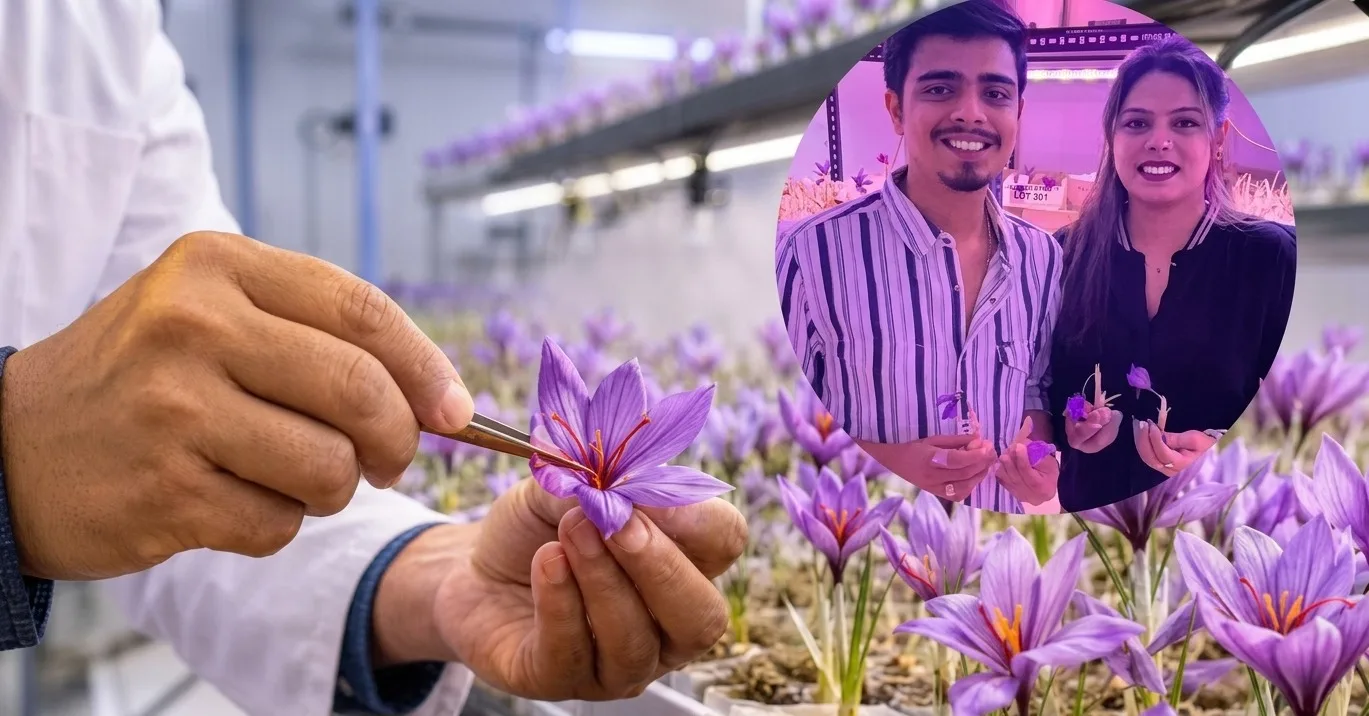
Saffron cultivation is traditionally associated with Kashmir in India. However, a couple from Nagpur, Maharashtra, has challenged that idea by successfully growing the expensive spice indoors using aeroponic technology.
Akshay Holi and his wife Divya Lohakare Holi have generated around Rs 1.3 crore in revenue over five years after investing approximately Rs 55 lakh in their indoor saffron farming business.
According to a report by The Times of India, the couple now earns between Rs 40 lakh and Rs 50 lakh annually from the venture. Their success demonstrates how modern agricultural technology can make high-value crop production possible beyond traditional farming regions.
How the couple started saffron farming
In 2020, Akshay, a Bachelor of Business Administration graduate, and Divya, a bank employee, began experimenting with saffron cultivation in an 80-square-foot vertical aeroponic unit on their rooftop in Loksseva Nagar, Nagpur.
Before launching the project, they spent nearly two years preparing for the venture. During that period, they travelled to Kashmir and spent around three and a half months learning traditional saffron cultivation techniques.
Akshay said India has strong demand for saffron, but domestic production remains relatively limited. Considering its high market value and demand, the couple decided to explore an alternative method of cultivation.
Growing saffron without soil
Aeroponics is a soil-free farming technique in which plant roots receive water and essential nutrients through a fine mist or spray. The method allows crops to grow in a controlled environment without traditional soil-based cultivation.
Although Nagpur experiences extremely high temperatures during summer, the couple maintains suitable conditions inside their farming units by controlling temperature and humidity.
They attempt to recreate environmental conditions similar to those found in Kashmir to support saffron growth.
Their harvesting season generally runs from August to December. The remaining months are dedicated to maintaining and developing the planting material for the next production cycle.
From a small experiment to larger production
The couple initially experimented with 100 saffron corms weighing around one kilogram in total. Their first production yielded only a few grams of saffron.
Over time, they expanded their operation and increased the quantity of planting material to around 350 kilograms, eventually producing approximately 1,600 grams of saffron.
They now operate cultivation units across two locations, including a flat in Hingna, with a combined cultivation area of around 480 square metres.
According to the report, their joint production reached 45 kilograms last year.
Saffron sells for Rs 630 per gram
After receiving grading from the Kashmir Saffron Institute, the couple sells their saffron for approximately Rs 630 per gram. At that rate, one kilogram is worth around Rs 6.3 lakh.
Their total investment over five years stands at approximately Rs 55 lakh, while revenue has reached around Rs 1.3 crore. Their current annual earnings are estimated at Rs 40 lakh to Rs 50 lakh.
Solar power helps reduce operating costs
Maintaining the right temperature and humidity is essential for indoor saffron cultivation, making electricity a major operational requirement.
The couple uses solar power to reduce electricity expenses. Since aeroponic farming does not require soil, they also avoid some of the fertiliser and labour costs associated with conventional agriculture.
Akshay estimates that setting up a 100-square-foot aeroponic unit could cost around Rs 10 lakh. According to his calculation, such a unit could produce saffron worth approximately Rs 5 lakh annually. He also claims the business can generate a profit margin of around 80 per cent.
The couple's experience highlights the potential of technology-driven agriculture in areas where traditional climate conditions are unsuitable for certain crops. However, anyone considering a similar venture needs to carefully assess technical requirements, investment costs, market demand and selling opportunities before getting started.





Comments
No comments yet. Be the first to write one.
Leave a comment