

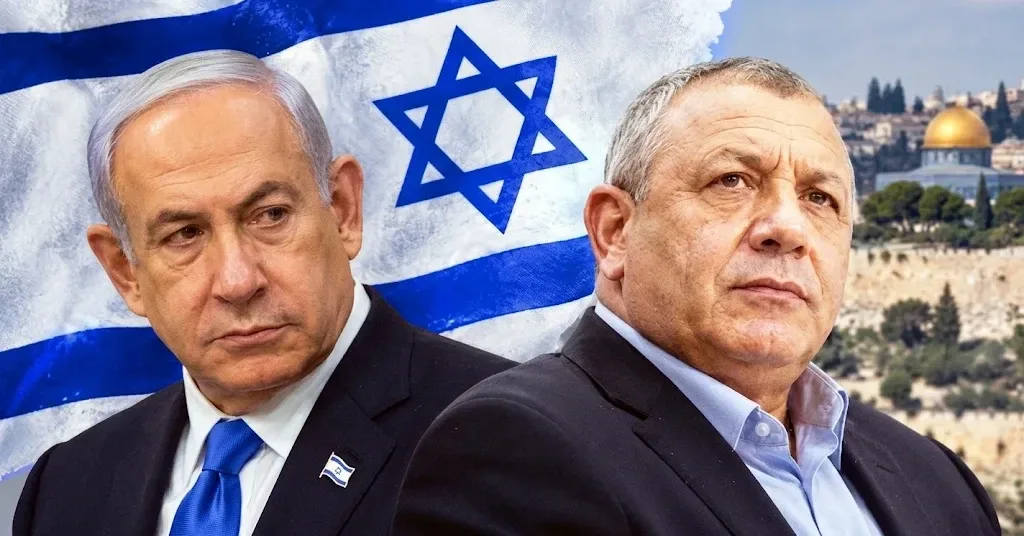
Israeli opposition leader Gadi Eisenkot has said Prime Minister Benjamin Netanyahu is not fit to remain in office “for even one more moment,” warning that his leadership threatens national security and deepens divisions in the country. Eisenkot made the remarks on Tuesday, November 10, in response to Netanyahu’s address at the swearing-in ceremony of the new parliament. He also called for the swift formation of a national emergency government.
Eisenkot, leader of the Yashar Party, described Netanyahu’s speech in parliament as shameful. He accused the prime minister of trying to spread division and hatred instead of bringing the country together. According to Eisenkot, Israel’s security will remain at risk as long as Netanyahu stays in power.
He argued that continued leadership under Netanyahu would further divide Israeli society and weaken the country’s ability to address its security challenges. Eisenkot said a national emergency government was urgently needed to help the country move beyond the current political crisis.
Yair Golan, leader of the Democrats Party, also criticised Netanyahu. Golan accused him of spreading falsehoods and provoking Arab citizens in an effort to remain in power. In a statement, Golan said Netanyahu would soon have to leave the prime minister’s office and take a seat in the opposition. He added that a government focused on reform and national recovery would be formed in Israel.
Earlier, after members of the new parliament were sworn in, Netanyahu called for the formation of a national unity government. He claimed that Iran was trying to revive its nuclear programme. Netanyahu also criticised the Joint List and the United Arab List after Eisenkot’s consideration of support from Arab parties in efforts to form a government. He accused the two groups of seeking to destroy Israel.
In the October 27 election, parties opposed to Netanyahu collectively secured 67 seats in the 120-member parliament. Arab parties won 19 of those seats. Netanyahu’s bloc, meanwhile, secured 53 seats, leaving the opposition with a parliamentary majority. The figures give Netanyahu’s opponents a numerical advantage, but they still need to reach agreement on a workable coalition to take power.
On Sunday, President Isaac Herzog tasked Eisenkot with forming a government. He has 28 days to complete the process, with the possibility of a further 14-day extension. However, coalition negotiations are facing significant obstacles. Ultra-Orthodox Jewish parties are demanding exemptions from compulsory military service, while some of Eisenkot’s allies object to relying on support from Arab parties.
The political uncertainty comes as Netanyahu faces a corruption trial in Israel. In November 2024, the International Criminal Court issued an arrest warrant for him over alleged war crimes and crimes against humanity in Gaza. The allegations and legal proceedings have added to the pressure surrounding his leadership as negotiations over a new government continue.






Comments
No comments yet. Be the first to write one.
Leave a comment