


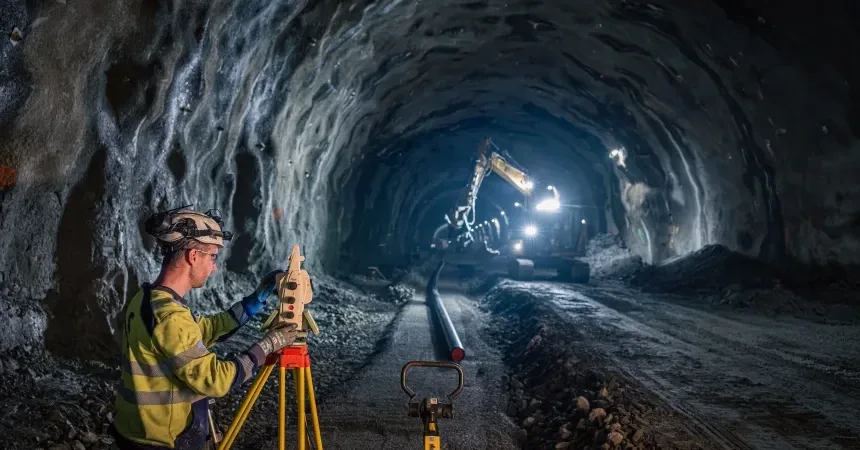
Norway is building what is set to become the world’s deepest and longest undersea road tunnel, a massive engineering project expected to transform transport along the country’s western coast.
Known as the Rogfast Tunnel, the 27-kilometre (17-mile) road link will reach a maximum depth of 392 metres (1,286 feet) below sea level. Once completed, it will replace several ferry connections and improve road travel between major Norwegian cities.
The name Rogfast comes from “Rogaland fastforbindelse,” referring to the Rogaland region and the Norwegian term for a fixed link.
Construction began in January 2018 but was suspended in late 2019 after projected cost overruns led to the cancellation of existing contracts and a restructuring of the project. Work resumed in late 2021, and completion is now expected in 2033. The estimated cost is around 25 billion Norwegian kroner, or approximately $2.4 billion.
According to Anne Brit Moen, a project manager at construction company Skanska, Rogfast will improve connectivity between the Stavanger and Haugesund regions by providing a faster and more reliable transport route.
The tunnel is expected to reduce travel time between Bergen and Stavanger by around 40 minutes. It will also make daily commuting easier by replacing existing ferry services.
The structure will consist of two separate tubes, each carrying two lanes of traffic. One of its most unusual features will be a double roundabout located approximately 260 metres below sea level. The roundabout will connect to a separate tunnel serving Kvitsøy, Norway’s smallest municipality.
Advanced technology for precision construction
Building a tunnel of this scale beneath the sea presents significant engineering challenges. Construction teams are excavating from both ends, aiming to meet in the middle with a margin of error of just five centimetres.
To achieve this precision, engineers are using advanced laser scanning technology. A rotating laser scanner collects around two million data points per second, creating a digital model of the excavated tunnel. Engineers then compare the model with the original design to identify possible inaccuracies.
Burkhard Boeckem, chief technology officer at Hexagon, the company providing measurement technology for the project, said the precision is important for reducing construction errors, costs, material waste and emissions.
Challenges beneath the sea
Rogfast is part of Norway’s wider plan to upgrade the 1,100-kilometre E39 coastal highway, which stretches from Trondheim in the north to Kristiansand in the south.
Currently, travelling the full route takes around 21 hours and involves seven ferry crossings. Norway aims to make the highway ferry-free through a combination of tunnels and bridges, potentially cutting journey times in half. The wider project is not expected to be completed before 2050.
However, construction has faced difficulties, particularly in preventing seawater from entering the tunnel. Moen said workers had already encountered significant saltwater leaks while excavating around 300 metres below sea level. Engineers are working to improve sealing methods as construction moves towards the planned maximum depth.
The tunnel will also feature ventilation systems designed to maintain air quality and protect motorists. Cameras, radar and real-time incident alerts will help monitor traffic and identify problems such as vehicle breakdowns and congestion.
Beyond transport, the project is expected to support regional development by improving access to employment, education and public services. It could also benefit Norway’s seafood industry by reducing transport costs and making logistics more efficient.
How Rogfast compares with other major tunnels
The Seikan Tunnel in northern Japan currently holds the record for the longest tunnel with an undersea section. The railway tunnel stretches 53.85 kilometres in total, including 23.3 kilometres beneath the sea.
The Channel Tunnel, connecting England and France, is 50.46 kilometres long, with an undersea section of 37.9 kilometres.
Although Rogfast will not be longer overall than either railway tunnel, its planned depth of 392 metres below sea level will make it exceptionally deep. For comparison, the Seikan Tunnel reaches approximately 240 metres below sea level, while the Channel Tunnel reaches around 115 metres.
When completed, Rogfast is expected to set a new benchmark for undersea road tunnel engineering and significantly change how people and goods move along Norway’s western coastline.





Comments
No comments yet. Be the first to write one.
Leave a comment