


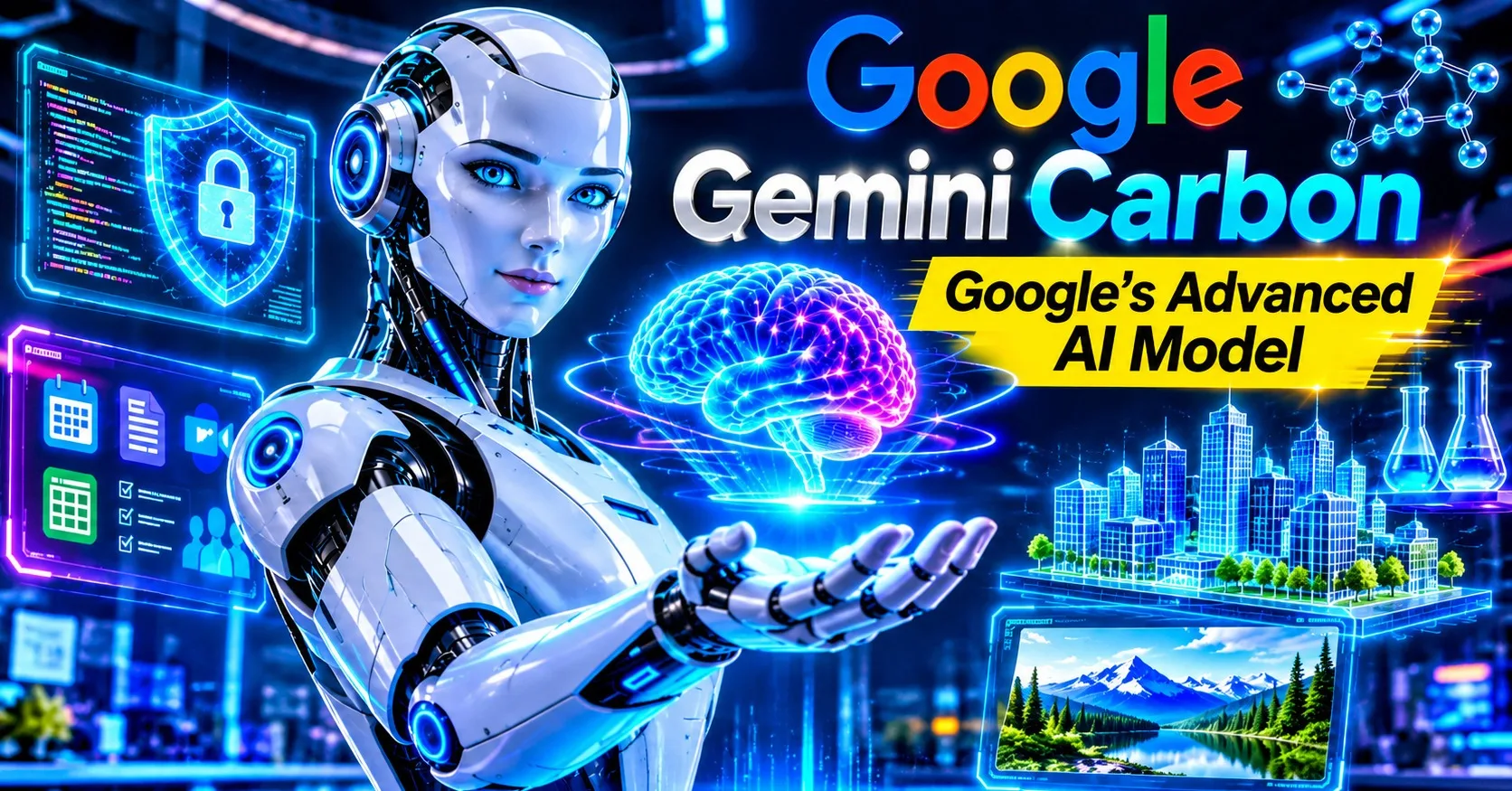
Gemini Carbon is attracting attention in the artificial intelligence industry with a range of advanced capabilities in software development, cybersecurity and scientific research. According to the information presented in the video, Google has introduced the model as its most powerful AI system so far. Initially released on October 28 to a limited group of cybersecurity researchers through its Fairwind programme, it is now being made available to developers and businesses through several Google platforms. The launch represents another major development in the global competition to build increasingly capable AI systems.
One of the model's most notable features is its performance in complex reasoning, coding and research tasks. The reported results show that it ranked first in several evaluations, including Cursorbench 4.0, Perplexity's Wander and Zapier's Automation Bench. It also achieved 96.2% on GraphWalks and recorded a score of 60 on the Artificial Analysis Intelligence Index in High mode. Google's pricing strategy reportedly starts at $2 per million input tokens and $10 per million output tokens during its promotional period. The company recommends using its Argon model for everyday tasks while reserving Carbon for more demanding work.
Cybersecurity is another important area where the technology could make a significant difference. According to the video, the model performed strongly in vulnerability discovery, exploitation and security remediation tests. Google's internal Project Fortify reportedly recorded 100% scanning recall and 95% triage precision. Cybersecurity company Wiz also used the model to identify previously unknown vulnerabilities in two major software-as-a-service providers in less than two hours. Another notable project involved verifying Signal's compiled encryption code using machine-checked mathematical proofs. The reported work generated approximately six to 6.5 million lines of Lean proofs over four weeks, highlighting the potential role of AI in software security.
Beyond cybersecurity, Google is exploring the model's potential in scientific discovery. Reported applications include analysing laboratory records, identifying possible drug toxicity mechanisms and investigating unexplained experimental results. In protein research, the model reportedly helped retrieve significantly more homologous sequences across seven low-homology protein families during the CASP 17 blind test. Google has also introduced a science access programme offering 10,000 researchers six months of free Antigravity access. Scientists working in physics, chemistry, biology, materials science and climate research are expected to benefit from the initiative. Such programmes could help researchers explore complex problems more efficiently.
Meanwhile, competition in the AI industry is expanding beyond Google's products. Anthropic has introduced several workplace-focused tools, including Claude Meetings, Claude Whiteboards, Claude Sheets and Claude Data. These tools are designed to support online meetings, collaborative planning, spreadsheet management and data analysis. The company is also expanding integrations with services such as Adobe, Atlassian and HubSpot. At the same time, Anthropic's reported IPO plans have attracted financial market attention, with Reuters reportedly discussing a potential capital raise of up to approximately $100 billion. These developments demonstrate how major technology companies are competing to make AI a practical part of everyday business operations.
Another development highlighted in the video is MiniMax H3 Image, an open-weights image generation model capable of producing native 4K images. It reportedly supports up to 16 reference images and prompts containing as many as 7,500 characters. Community demonstrations have explored realistic character images, detailed architectural blueprints, CAD-style illustrations and complex visual simulations. The model also showed promising results in sign-language fingerspelling tests, although smaller text may still present challenges. Together, these developments point towards a rapidly changing AI landscape. From advanced reasoning and digital security to scientific research and creative image generation, artificial intelligence is becoming increasingly influential across industries worldwide.



Comments
No comments yet. Be the first to write one.
Leave a comment