


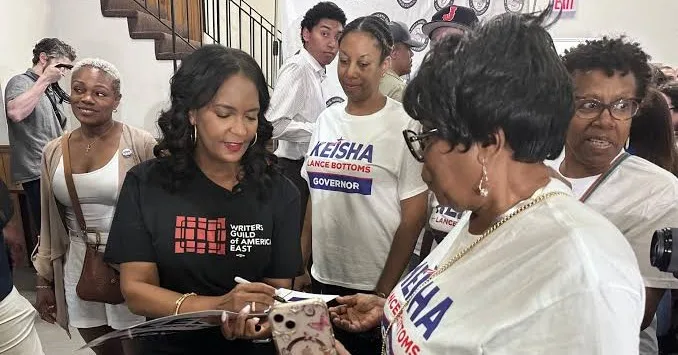
Black women voters and grassroots organisers played a major role in the Democratic Party's historic gains across the southern United States in the 2026 midterm elections. Their support helped elect new political leaders, strengthen Democratic campaigns and challenge Republican dominance in several traditionally conservative states.
The election results highlighted the influence of Black women in shaping political outcomes, particularly in Mississippi and Georgia. Their voting participation, community organising and long-term grassroots efforts helped build momentum for Democratic candidates across the region.
In Mississippi, Democrat Scott Colom defeated Republican incumbent Cindy Hyde-Smith in the US Senate race. His victory made him the state's first Black senator since the Reconstruction era and its first Democratic senator since 1982. The result was especially significant in a state where Donald Trump won by a wide margin in 2024.
Black women were also central to Democratic victories in Georgia. Former Atlanta Mayor Keisha Lance Bottoms made history by becoming the first Black woman elected governor of a US state. Several other Black women also secured statewide offices, including positions in the attorney general's office, secretary of state and education leadership.
Black women's political influence extended beyond individual candidates. Community-based organisations and voting rights groups spent years registering voters, educating communities and encouraging participation. Former Georgia state legislator Stacey Abrams and other activists were among those whose organisations invested in voter engagement efforts in Mississippi and across the South.
In Georgia, more than 560,000 Black women reportedly voted early before the November 3 election, a 31% increase compared with 2022, according to an analysis published by The American Prospect. The same analysis reported that 99% of Black women voters in Mississippi supported Colom, based on exit-poll estimates.
The impact was also visible in Florida, where Democratic Senate candidate Angie Nixon came within three percentage points of defeating Republican incumbent Ashley Moody. Exit-poll figures cited by The American Prospect indicated that 94% of Black women voters supported Nixon.
Across the region, Black voters also helped Democratic candidates overcome Republican redistricting efforts. In Alabama, Congressman Shomari Figures won re-election despite changes to his district, while North Carolina Congressman Don Davis also retained his seat.
Voting rights concerns were another important factor in the election. Activists said efforts to weaken voting protections and reduce Black political representation encouraged communities to participate. However, voter data alone cannot establish the personal motivations behind every ballot.
The results have renewed calls for the Democratic Party to invest more consistently in Southern communities rather than focusing mainly on competitive states during election campaigns. Former Vice President Kamala Harris and voting rights advocates have described the results as a wake-up call for party leaders.
The 2026 elections demonstrated how sustained grassroots organising, voter participation and community leadership can influence political outcomes. Black women, both as voters and organisers, played a significant role in shaping the Democratic gains across the South.





Comments
No comments yet. Be the first to write one.
Leave a comment