


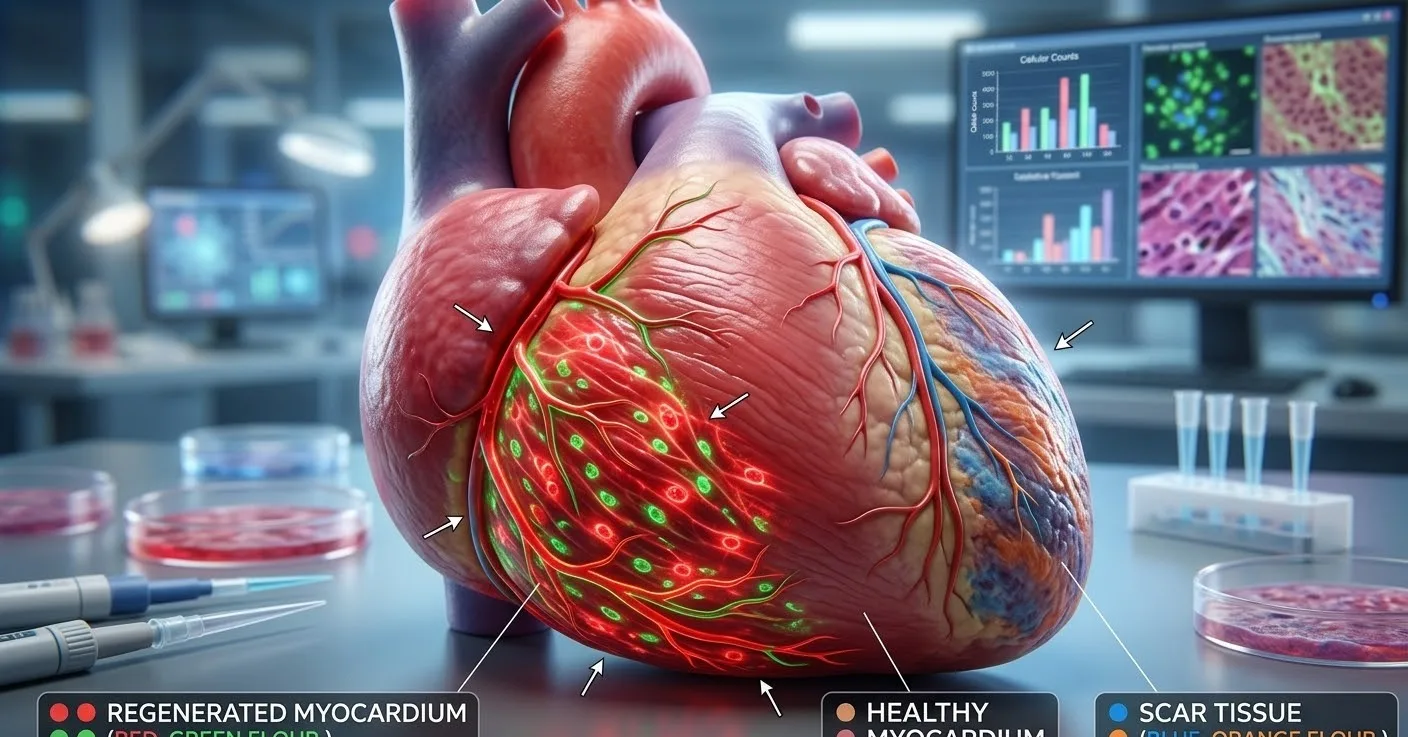
Scientists have developed an experimental approach that could help damaged hearts repair themselves by encouraging heart muscle cells to grow again after a heart attack. The technique has shown promising results in mice, raising hopes for future treatments for heart failure.
The research was conducted by scientists from the University of Cambridge, Australia's QIMR Berghofer Medical Research Institute and pharmaceutical company AstraZeneca. The team used a temporary messenger RNA (mRNA) treatment to activate proteins that encourage heart muscle cells to divide.
Heart muscle cells in adults rarely regenerate naturally. As a result, damage caused by a heart attack is often permanent. A severe heart attack can destroy up to a billion heart muscle cells, leaving the heart less capable of pumping blood effectively.
In the experiment, researchers delivered short-lived mRNA into the heart following a heart attack. The mRNA temporarily activated two proteins, Myc and cyclin T1, which help control cell growth and division.
The treatment encouraged heart muscle cells to begin dividing again. The mRNA gradually faded away after delivering its instructions.
According to the study, treated mice pumped approximately 10% more blood with each heartbeat than untreated animals. The improvement remained noticeable 12 weeks after treatment.
The findings were published in the journal Nature Cardiovascular Research.
Existing heart failure medications mainly help reduce the workload on a damaged heart and manage symptoms. However, they do not replace heart muscle cells lost during a heart attack.
Cambridge researcher Catherine Wilson said the approach could potentially move treatment beyond symptom management and help the heart repair itself. The British Heart Foundation has also described the possibility of restoring the human heart's ability to repair itself as a major goal in cardiology.
Despite the promising findings, significant challenges remain before the treatment can be tested in people. So far, the results have come from animal experiments involving mice. The method used to deliver the mRNA is also not yet suitable for clinical use in humans.
Long-term safety is another major concern. Myc is a well-known cancer-related gene, and activating it raises questions about the possibility of uncontrolled cell growth. Researchers reported no tumours in the treated mice during the study period, but longer-term investigations are necessary.
With funding from the British Heart Foundation, the next stage will involve testing the treatment in larger animals. Scientists hope this research will help establish whether the technique can eventually move towards human clinical trials.





Comments
No comments yet. Be the first to write one.
Leave a comment