


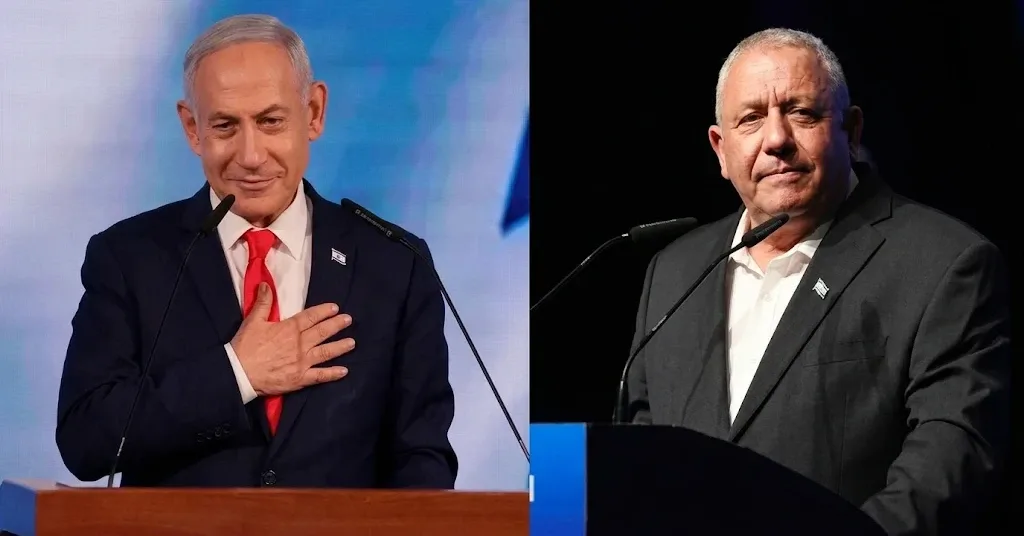
Israel’s Likud party, led by caretaker Prime Minister Benjamin Netanyahu, and the centrist Yashar party of Gadi Eisenkot began a fresh round of talks on Sunday (November 22) to explore the possibility of forming a national unity government.
According to Israeli media reports, representatives of the two parties met at a hotel in Herzliya, near Tel Aviv, at 1:00 pm local time. The meeting marked the second consecutive Sunday of negotiations between the rival political camps.
Eisenkot, a former Israeli military chief, has until December 6 to form a government after the October election failed to give either major bloc a parliamentary majority. The deadline can be extended by another 14 days.
However, his camp remains divided over the best route to forming a coalition. The options include reaching an agreement with ultra-Orthodox Jewish parties, securing cooperation from Arab-led parties, or forming a national unity government with Netanyahu’s Likud.
On Saturday, Yashar described the decision to resume negotiations as a “genuine commitment” to forming a government. The party said Eisenkot had instructed his negotiating team to explore all possible options.
Likud Sets Conditions for Unity Government
Likud has already outlined several conditions for joining a national unity government. Among its demands are an end to personal attacks and what it describes as incitement against Netanyahu and his outgoing government.
The party has also called for a joint declaration by all participating parties recognising Israel as the nation-state of the Jewish people, while ruling out the involvement of Arab parties.
Netanyahu and his allies have frequently opposed cooperation with Arab-led parties, which secured a record 19 seats in the October election. These parties are also opposed to Netanyahu remaining in power.
Likud is seeking agreement on several major policy issues, including rejecting the establishment of a Palestinian state, maintaining Israeli control over territories in Syria, Lebanon and the Gaza Strip, and reaching an understanding on military service for ultra-Orthodox Jews.
Opposition to Netanyahu Remains a Major Obstacle
Despite the renewed negotiations, Eisenkot has previously ruled out serving in a government led by Netanyahu. Former prime minister Naftali Bennett, an important ally in Eisenkot’s camp, reiterated on Saturday that his party would not join a government led by Netanyahu or his political bloc under any circumstances.
On Friday, Eisenkot warned that he would not allow the negotiations to drag on indefinitely. He said he was prepared to put forward an “emergency national government” for a vote in parliament if efforts to form a broader coalition failed.
His remarks indicate a possible two-stage strategy: first establishing a minority government with support from key opposition groups, then seeking to expand it.
The negotiations come as Israel faces a complicated political deadlock, with neither major bloc holding enough seats to govern independently. Whether the latest talks can bridge the divisions between the rival camps remains uncertain.





Comments
No comments yet. Be the first to write one.
Leave a comment