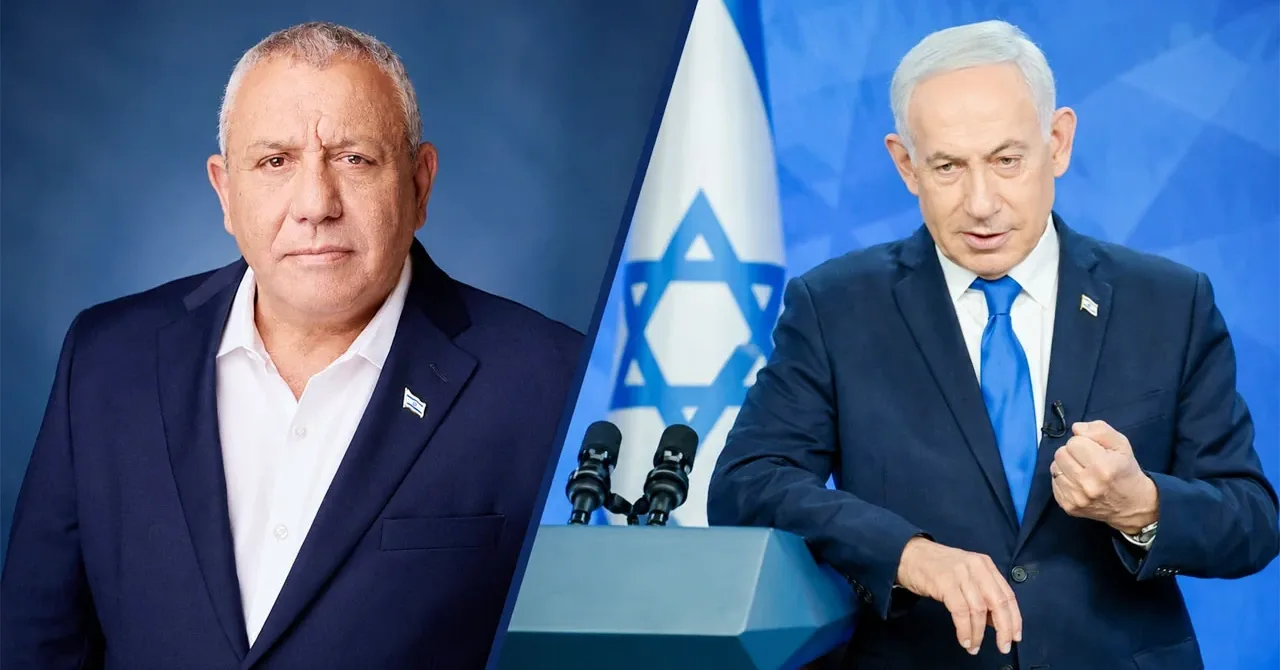
Israel’s former army chief and centrist leader Gadi Eisenkot has invited the right-wing Likud Party of his political rival, Benjamin Netanyahu, to coalition talks as he seeks to form the country’s next government. The move has opened a new chapter in Israel’s political negotiations, with efforts underway to establish a broad national unity government. Eisenkot’s centrist Yashar Party announced the decision in a statement on Saturday (November 21), saying talks with Likud would begin on Sunday and continue through a series of meetings.
No political bloc secured an outright majority in Israel’s October election, leaving the country facing difficult coalition negotiations. Eisenkot has been given until next month to form a new government. According to the Yashar Party, inviting Likud is part of a sincere effort to establish the broadest possible government. However, disagreements within Eisenkot’s own alliance have complicated the process, particularly over which political groups should be included in the proposed coalition.
According to an AFP report, the alliance is divided over whether to form a government with ultra-Orthodox Jewish parties, Arab-majority parties or Netanyahu’s political bloc. The disagreement has exposed significant differences among the alliance’s leading figures. Former Prime Minister Naftali Bennett, one of the key leaders in Eisenkot’s alliance, made his position clear on Saturday. He said he wanted a government led by Eisenkot but ruled out any possibility of his party joining Netanyahu or his political bloc.
Eisenkot had previously indicated that he was willing to form a government with members of Likud but would not serve under Netanyahu’s leadership. Netanyahu, meanwhile, has consistently called for a national unity government, citing Israel’s security concerns. The latest invitation from Eisenkot has therefore created an opportunity for discussions between the rival political camps, although major differences remain over leadership and policy.
Following the invitation, Likud outlined its position and several conditions for joining a coalition government. The party said all personal attacks, incitement and political boycotts directed at Netanyahu and his government must end before a unity arrangement can be reached. Likud has also proposed a joint declaration involving all parties that recognise Israel as the nation-state of the Jewish people. However, it has made clear that Arab parties must not be included in the government.
Netanyahu and his allies have repeatedly criticised Arab political leaders for refusing to describe Hamas as a terrorist organisation, despite condemning the October 7, 2023 attacks. This disagreement remains another major obstacle to forming a broad-based coalition.
Likud has also presented several policy demands concerning Israel’s regional security and military strategy. Its proposed framework rejects the establishment of a Palestinian state and calls for maintaining Israeli security zones in Syria, Lebanon and Gaza. The party has also proposed reaching an agreement with leaders of the ultra-Orthodox Jewish community over military service requirements for members of the community.
Despite the growing disagreements, Eisenkot has indicated that he does not want coalition negotiations to continue indefinitely. On Friday, he said he was unwilling to waste time on prolonged political discussions. If efforts to establish a broad national unity government fail, he is prepared to propose a minority national emergency government and seek parliamentary approval through a confidence vote.
The coming days are expected to be important for Israel’s political future. The outcome of talks between Eisenkot and Likud, along with the ability of his alliance to overcome internal disagreements, will play a significant role in determining the country's next government.





Comments
No comments yet. Be the first to write one.
Leave a comment