


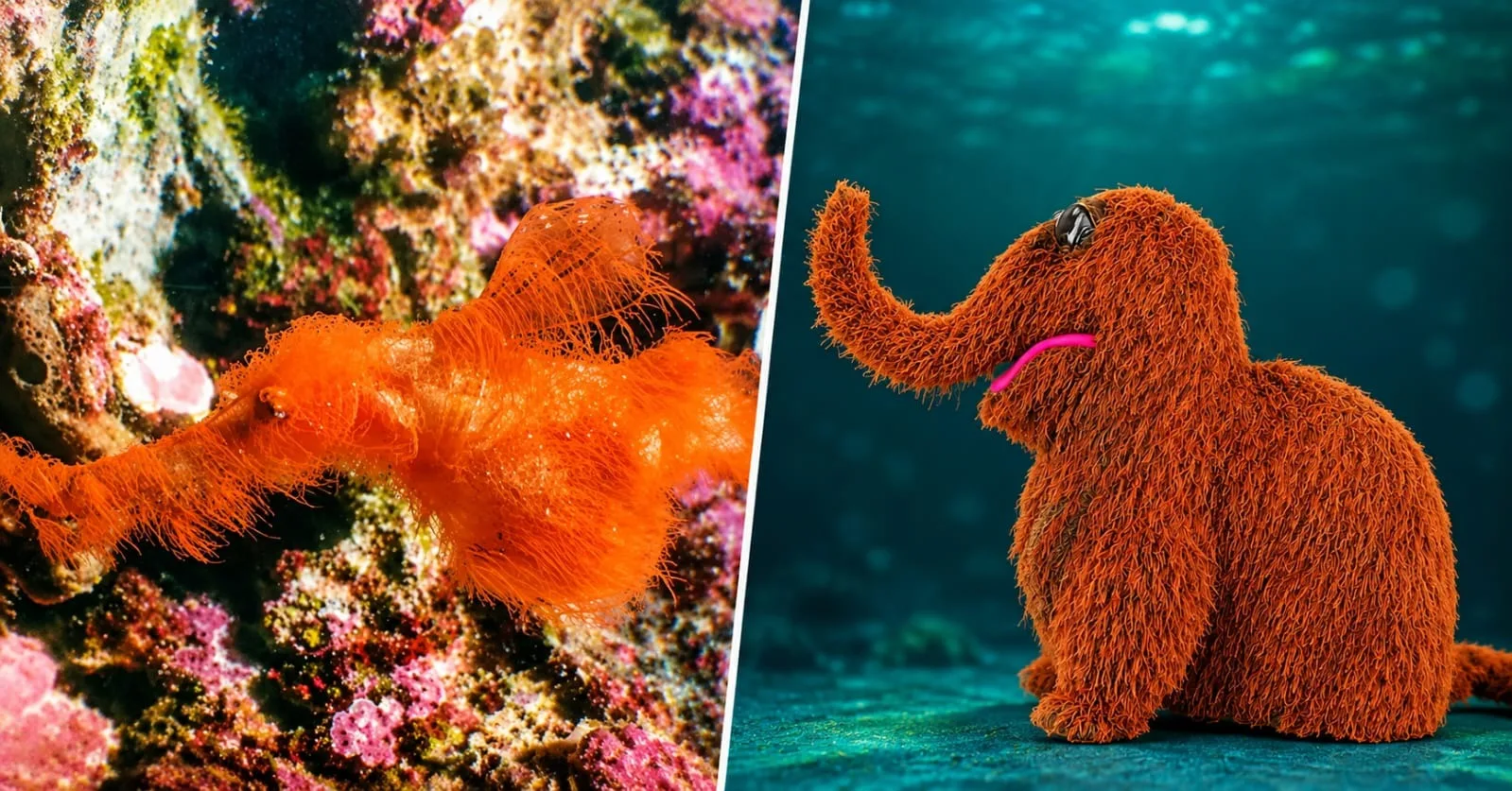
Over the past century, scientists have uncovered countless remarkable creatures in Australia's iconic Great Barrier Reef. Yet one peculiar fish managed to remain hidden from science until now. In a study published this month in the journal Fish Biology, researchers announced the discovery of a brand-new species of ghost pipefish named Solenostomus snuffleupagus.
The quirky name comes from the fish's striking resemblance to Mr. Snuffleupagus, the beloved mammoth-like furry character from the children's television show Sesame Street.
A Two-Decade Search
The story began more than 20 years ago when marine scientist David Harasti of Australia's Port Stephens Fisheries Institute spotted a bizarre fish while scuba diving in Papua New Guinea. Its snout was as long as its body, and it was covered in wavy, brownish-orange hair-like filaments that blended seamlessly into the surrounding algae. Unable to forget it, Harasti promised a colleague that if it turned out to be a new species, he would name it after Mr. Snuffleupagus.
Joined by ichthyologist Graham Short of the California Academy of Sciences, Harasti embarked on a nearly 20-year quest-making five trips back to Papua New Guinea while Short scoured museum collections worldwide-without any luck. The breakthrough finally came in 2021 when scuba divers reported seeing a short, hairy fish in the Great Barrier Reef. Rushing to the site, the two scientists came up empty on their first dive, but on the second, a pair of the elusive ghost pipefish appeared right before them. Recalling the moment, Short said they hugged, shook hands, and he even shouted with joy underwater.
Tiny Yet Fierce DNA testing in the lab confirmed that the creature is a distinct new species of ghost pipefish. Resembling bits of coral or drifting algae-and visually similar to, though separate from, seahorses-Solenostomus snuffleupagus measures only 4 to 5 centimeters long, about half the size of other ghost pipefish. Despite its tiny frame, it is a surprisingly aggressive predator; a lab CT scan stunned researchers by revealing the skeleton of an entire small fish inside its stomach.
Its most defining feature is the coat of soft, hair-like filaments covering its body. Data from the citizen-science platform iNaturalist indicates the species has also been spotted in recent years in Tonga, Papua New Guinea, and New Caledonia across the South Pacific. Depending on their habitat, their colors vary widely-from bright red and purple to earthy dark orange and brown.






Comments
No comments yet. Be the first to write one.
Leave a comment