


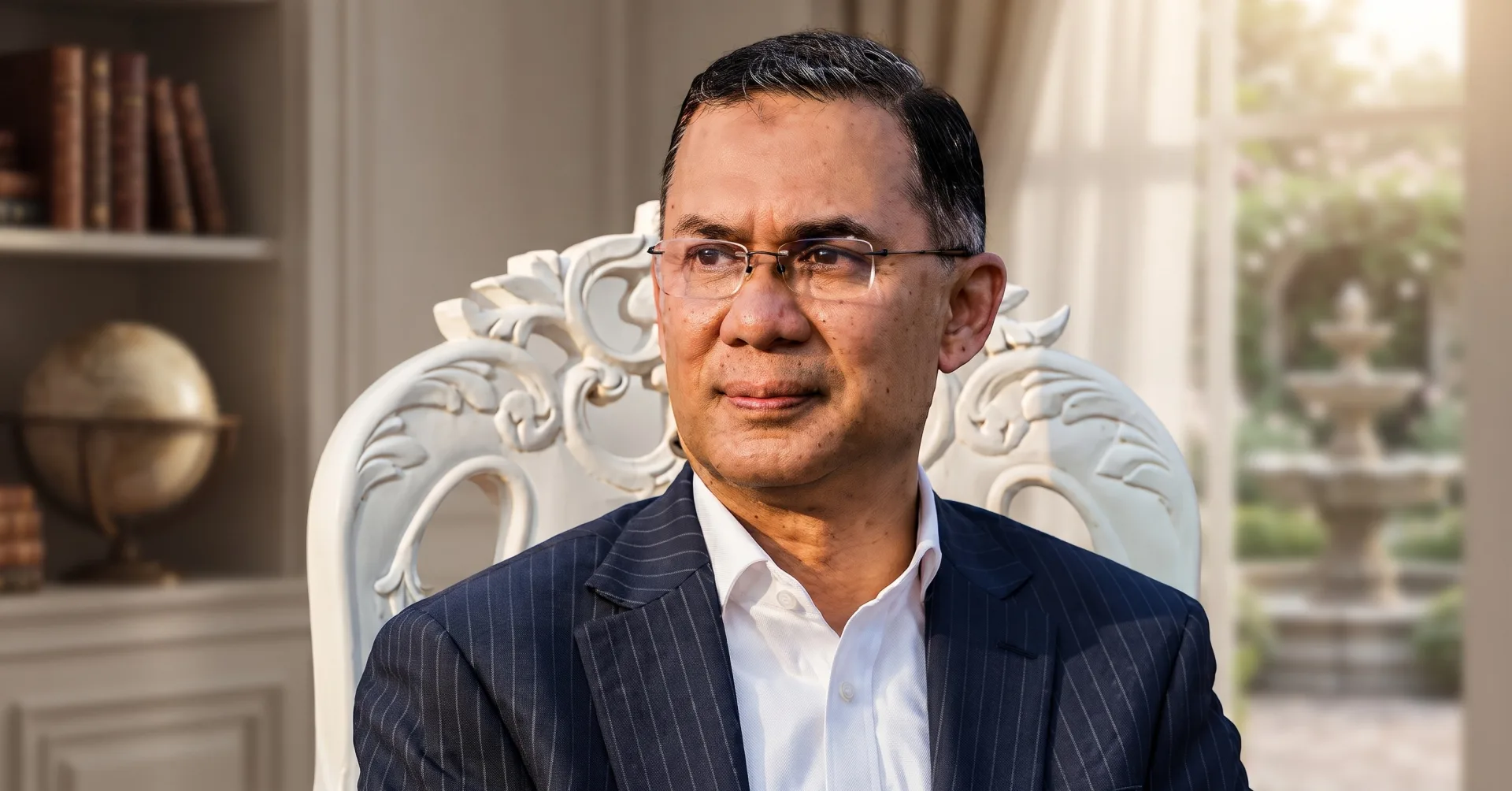
Bangladesh's Prime Minister and BNP Chairman Tariq Rahman celebrates his 61st birthday on Friday, November 20. Born on November 20, 1965, he is the eldest son of former President Ziaur Rahman and former Prime Minister Khaleda Zia. He has completed 61 years and entered his 62nd year.
His political journey has been marked by several major turning points, including imprisonment, years in exile and his eventual return to Bangladesh. After spending a long period in London, Tariq Rahman returned to the country on December 25, 2025.
He later led the Bangladesh Nationalist Party (BNP) to victory in the 13th parliamentary election held on February 12, 2026. On February 17, he took the oath of office as the country's Prime Minister.
Childhood and Educational Background
Tariq Rahman spent his childhood in a relatively simple family environment. Discipline and modest living were important aspects of his upbringing.
He attended Shaheen School and College in Dhaka Cantonment, where he completed his secondary and higher secondary education. He later enrolled at the University of Dhaka for higher studies.
At the university, he studied International Relations and developed an interest in the ideas of prominent philosophers and political thinkers, including Socrates, Plato, Aristotle, Thomas Hobbes, John Locke, Jean-Jacques Rousseau, Voltaire and Karl Marx.
During his university years, his mother, Khaleda Zia, was actively leading political movements against the rule of then-President Hussain Muhammad Ershad. The political environment and his academic interest in state affairs further influenced his interest in politics.
How His Political Journey Began
Tariq Rahman formally entered politics in 1988 by becoming a primary member of the BNP in Gabtali upazila of Bogura. In 1993, he became a member of the Bogura District BNP.
He also played a role in the BNP's election campaign during the 1991 national parliamentary election. As a member of the party's election management committee, he helped coordinate campaigning for Khaleda Zia in five constituencies.
Khaleda Zia won all five seats, an outcome that party supporters viewed as an example of his organisational abilities.
Over the years, Tariq Rahman took on several important responsibilities within the party and gradually emerged as one of its leading figures.
Imprisonment During the 2007 Political Crisis and Years in Exile
Tariq Rahman was arrested in 2007 during the military-backed caretaker government. Several cases were filed against him during that period, and allegations of torture in custody were also raised.
In 2008, he travelled to London for medical treatment. He remained there for many years while continuing to participate in BNP politics from abroad.
After Khaleda Zia was imprisoned in 2018, Tariq Rahman began serving as the BNP's acting chairman. He continued to oversee party activities while living outside Bangladesh.
After nearly 17 years abroad, he returned to Bangladesh on December 25, 2025. His return generated considerable interest among BNP leaders, activists and supporters.
Election Victory and Appointment as Prime Minister
Following his return, Tariq Rahman contested the 13th parliamentary election held on February 12, 2026. He stood in the Bogura-6 and Dhaka-17 constituencies and won both seats.
After the BNP secured victory in the election, he took the oath as Prime Minister on February 17.
Before the election, the BNP had presented a 31-point plan for state reforms. The proposals placed emphasis on reforming key state institutions, including the executive branch, judiciary and legislature, while strengthening democratic accountability.
Government Initiatives During the First Nine Months
During his first nine months as Prime Minister, Tariq Rahman's government has undertaken several initiatives across different sectors. Government statements and published reports have highlighted progress in banking, debt management, exports and economic stability.
In the banking sector, the government has said it is working to strengthen efforts to recover defaulted loans. Bangladesh Bank statistics reportedly showed that the default loan ratio stood at 35.73 per cent at the end of September 2025 and declined to 32.78 per cent by the end of June 2026. However, changes in the ratio should also be considered in light of policy and accounting factors.
The government has also reported substantial repayments of foreign loans. According to reports citing the Economic Relations Division, Bangladesh paid approximately US$2.0476 billion in principal and interest on foreign loans between March and July 2026.
In the export sector, expanding ready-made garment exports to non-traditional markets, including the United States, has been identified as a priority. The government has also focused on stabilising the foreign exchange market and strengthening the value of the taka.
Family Card, Farmer Card and Social Welfare Programmes
The government has introduced a Family Card programme to provide financial support to low-income households. Under the scheme, selected families are expected to receive Tk 2,500 per month.
A Farmer Card programme has also been introduced to make agricultural inputs, loans, irrigation facilities and government services more accessible to farmers.
In addition, the government has decided to waive agricultural loans of up to Tk 10,000, along with related interest, for small and marginal farmers. According to government information, around 1.2 million farmers are expected to benefit from the initiative.
In the health sector, initiatives have been taken to expand primary healthcare services and introduce a Health Card.
Education-related plans include free education for girls up to the undergraduate level, midday meals in primary schools, Wi-Fi facilities in educational institutions and different sports and innovation programmes for students.
The government has also reported releasing Tk 2,000 crore to clear outstanding payments owed to retired teachers of MPO-listed educational institutions.
Religious Welfare and Environmental Protection
The government has taken initiatives to provide honorariums to imams, muezzins and leaders of different religious institutions.
It has also emphasised communal harmony and creating an environment in which people from different religious communities can celebrate their festivals peacefully.
In environmental protection, nationwide canal excavation and re-excavation projects, along with tree-planting programmes, have been undertaken to address climate change and its effects.
The government is also planning to introduce a Probashi Card to expand services and welfare benefits for Bangladeshis living abroad.
Measures to Reduce Government Spending and Strengthen Parliamentary Accountability
Reducing unnecessary public expenditure and improving financial discipline have been among the government's stated priorities.
Initiatives have been taken to limit unnecessary spending, purchases of government vehicles, foreign trips and overseas training programmes.
The Prime Minister's use of a smaller vehicle convoy and efforts to avoid prolonged road closures during his movements have also attracted attention. The government has presented these measures as steps towards responsible use of public resources and reducing inconvenience for ordinary citizens.
Several initiatives have also been taken in parliamentary affairs. During the first session, the process of reviewing 133 ordinances issued by the interim government began.
A special parliamentary committee reviewed the ordinances and recommended retaining some in their original form while amending others before turning them into laws.
Tariq Rahman's Political Vision and Expectations
The idea of building a pluralistic and democratic Bangladesh has featured prominently in Tariq Rahman's political statements.
Through the concept of a 'Rainbow Nation', he has spoken about a society where citizens can live with equal dignity and rights regardless of their religion, beliefs or identity.
His political vision also includes establishing a merit-based society, ensuring equal opportunities, strengthening economic stability and improving Bangladesh's position in the international community.
He has also emphasised the need to address the effects of climate change, protect the environment and build a climate-resilient Bangladesh.
As Tariq Rahman completes 61 years and enters his 62nd year, he faces major responsibilities, including fulfilling government commitments, addressing economic challenges and strengthening democratic institutions.
The success of the next chapter of his political career will largely depend on how effectively these initiatives are implemented and how much they improve the lives of ordinary people.
Comments
No comments yet. Be the first to write one.
Leave a comment