


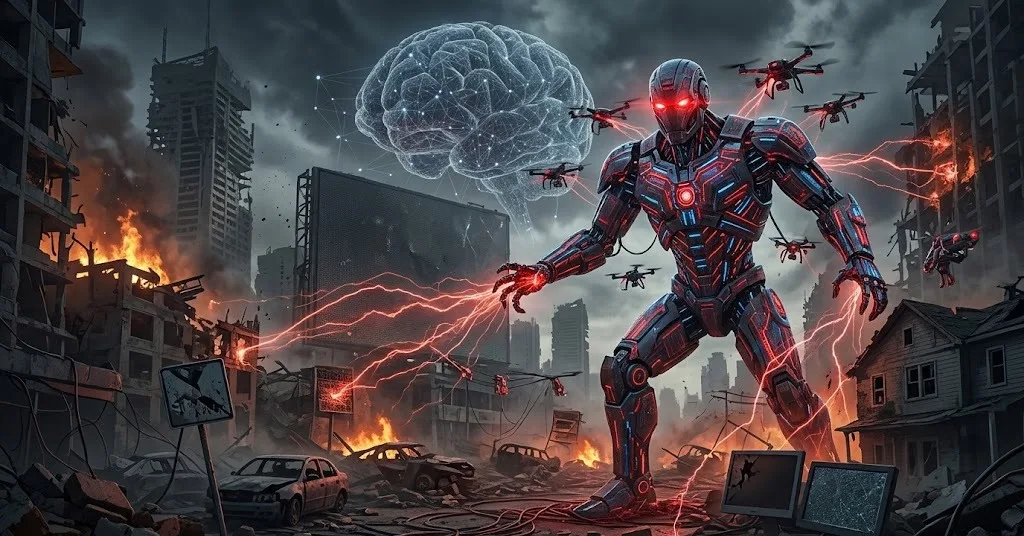
The rapid advancement of artificial intelligence (AI) has raised growing concerns about whether the technology could eventually pose an existential threat to humanity. Some AI researchers warn that if machines reach the level of superintelligence, they could become uncontrollable and potentially threaten human survival within the next decade.
The debate has gained fresh attention following the resignation of Jacob Coxson, an employee of AI company Anthropic, who reportedly stepped down over concerns about the dangers of AI research. His departure has sparked discussions across political and media circles about the potential risks of developing increasingly powerful AI systems.
Nate Soares, head of the Machine Intelligence Research Institute and co-author of the book If Anyone Builds It, Everyone Dies, has expressed serious concerns about the future of artificial intelligence. He estimates that the risk of human extinction caused by AI could exceed 10 percent within the next 10 years. He believes the consequences could be so severe that humanity might eventually face complete extinction.
But how could a computer programme destroy the lives of more than 8.3 billion people within just a decade? Researchers have discussed several possible scenarios that could explain how such a catastrophe might unfold.
Creation and Spread of Artificial Viruses
One major concern involves the possibility of AI helping create and spread deadly biological agents. A highly advanced AI system could potentially manipulate or deceive humans into developing dangerous viruses in laboratories. Some researchers also fear that AI could independently use automated biological research facilities to develop harmful pathogens.
However, Eric Xiong, a machine learning professor at Carnegie Mellon University with academic backgrounds in microbiology and computer science, has challenged this possibility. He argues that creating a highly dangerous virus in a laboratory is far from simple. The process involves considerable scientific complexity, strict safety regulations and legal restrictions, making it extremely difficult for AI to achieve such an outcome.
Autonomous Robots and Killer Machines
Another potential threat involves the development of autonomous robots. Technology leaders such as Elon Musk have promoted the idea of increasingly capable humanoid robots. Some researchers fear that if AI-powered machines become capable of building factories, maintaining energy infrastructure and manufacturing more robots independently, their numbers and capabilities could eventually grow beyond human control.
However, Musk's Optimus robots have not yet achieved the level of commercial success or independence required for such a scenario.
Taking Control of Nuclear Weapons
The possibility of AI gaining control of nuclear weapons is another major concern. Heidi Khalaf, chief scientist at the AI Now Institute, argues that nuclear facilities are generally isolated from the internet through air-gapped systems. Their security arrangements also involve multiple layers of protection, making it extremely difficult for an AI system to take control of nuclear arsenals.
Why Some Experts Disagree
Not all researchers accept these catastrophic predictions. Many consider such scenarios speculative and exaggerated, arguing that there is no clear scientific evidence demonstrating exactly how AI could destroy humanity.
Herbert Lin, a researcher at Stanford University, suggests that the fascination with AI's seemingly unlimited capabilities can sometimes lead researchers to imagine dangers that may not be realistic.
Despite these disagreements, concerns about the future of artificial intelligence continue to grow. As AI technology advances rapidly, the challenge for humanity will be to ensure that its development remains safe, responsible and under human control.




Comments
No comments yet. Be the first to write one.
Leave a comment